
TL;DR

Get everyday essentials delivered free with Prime
- Fast, free delivery on millions of items
- Prime Video, Amazon Music and more included
- Member-only deals all year
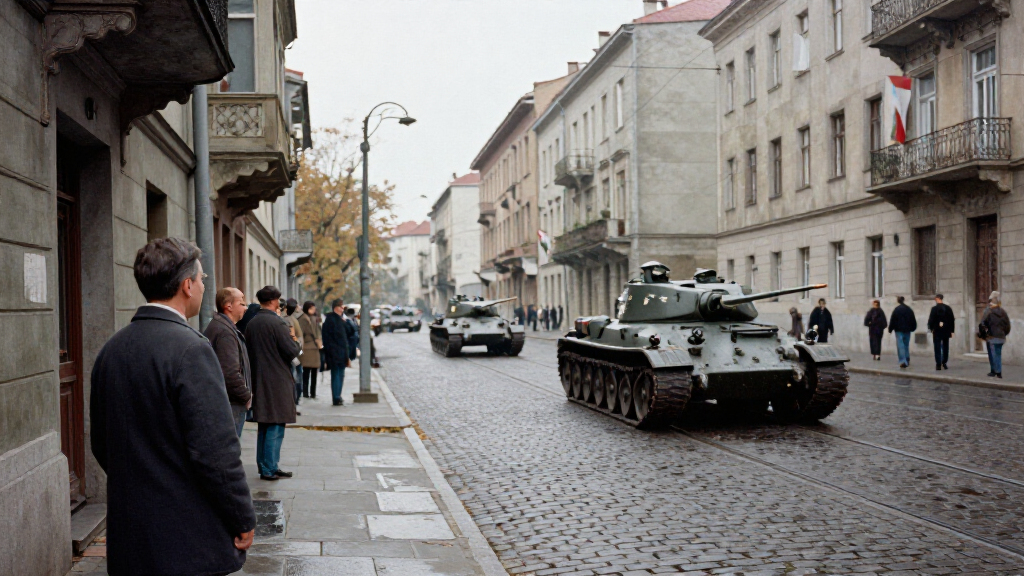
Moscow initially agreed to withdraw Soviet troops from Budapest during Hungary’s 1956 uprising, then reversed course and launched a major military operation on November 4. The invasion crushed the revolt, killed thousands and drove about 200,000 Hungarians to leave the country. Western governments condemned the intervention but did not send forces to help the insurgents.
The Soviet Union agreed to withdraw troops from Budapest during Hungary’s 1956 uprising, but reversed course and launched a large-scale military operation on November 4, crushing the revolt, according to a Meduza report published October 24, 2026. The intervention ended Hungary’s brief challenge to Soviet control and left thousands dead, while about 200,000 Hungarians fled the country.
The revolt began on October 23, 1956, when hundreds of thousands of Budapest residents demonstrated for political reforms, free elections and the removal of Soviet troops. What began as peaceful protest quickly became an armed uprising. Within days, Hungary appeared close to leaving the Soviet bloc, Meduza reported.
Soviet leaders first made concessions, including agreeing to pull troops out of the capital. About one week later, on November 4, Soviet forces began an operation involving around 60,000 soldiers, according to the source material. The military intervention defeated the uprising. The report says thousands died and approximately 200,000 people left Hungary; it does not provide a more precise death toll.
Western governments condemned Moscow’s actions but did not intervene militarily. The episode is the subject of a Meduza interview with historian Alexey Uvarov, which examines the revolt, the reversal in Soviet policy and the limits of Western support. The report also asks why the events remain politically disputed in Hungary seven decades later.
The Cost of Moscow’s Reversal
The episode showed the limits of political concessions inside the Soviet sphere: when the uprising threatened Hungary’s place in that bloc, Moscow chose military force over the troop withdrawal it had agreed to. The result was the suppression of the revolt and a major displacement of Hungarians, with lasting consequences for families and the country.
It also exposed the gap between Western public language about freeing Eastern Europe and the decisions leaders were willing to make. The report says governments condemned the invasion but stopped short of direct military action, in part against the backdrop of Cold War risks. The choice left Hungarian insurgents without outside armed support.
The 70th anniversary in 2026 provides the immediate occasion for renewed attention. The questions raised by the uprising—Soviet power, national self-determination and Western limits—remain relevant to how the events are remembered and debated in Hungary.
Hungarian Revolution of 1956 history book
As an affiliate, we earn on qualifying purchases.
As an affiliate, we earn on qualifying purchases.
Reform Hopes Before the Uprising
The 1956 revolt unfolded amid changes in Soviet policy after Joseph Stalin’s death. At the Soviet Communist Party’s 20th Congress in February 1956, leader Nikita Khrushchev condemned Stalin’s cult of personality and mass repression in a secret speech. Soviet officials also spoke of different national paths to socialism. Across Eastern Europe, those signals encouraged debate about reforms and reduced control from Moscow, though the limits of change remained uncertain.
Hungary was part of the Soviet-led Eastern European bloc, where communist governments operated under Moscow’s influence. The broader Cold War raised the stakes: NATO had formed in 1949, and the Soviet Union and its Eastern European allies established the Warsaw Pact in 1955. Both superpowers had nuclear weapons, making direct confrontation dangerous.
Events elsewhere also shaped Western calculations. The United States had not intervened when Soviet troops crushed an uprising in East Germany in 1953. In autumn 1956, the Suez Crisis divided Western governments as Britain, France and Israel attacked Egypt. Meduza’s report presents these developments as part of the international setting in which the Hungarian revolt and the response to it unfolded.
“Moscow agreed to withdraw its troops from Budapest. One week later, it launched a 60,000-soldier operation to crush Hungary’s revolution.”
— Meduza’s report
Hungary 1956 uprising Soviet invasion documentary DVD
As an affiliate, we earn on qualifying purchases.
As an affiliate, we earn on qualifying purchases.
Details Still Not Specified
The account gives a broad description of the Soviet reversal and the November 4 operation, but it does not detail the negotiations behind the troop-withdrawal agreement or identify the specific decision-making sequence that led Moscow to change course. It also gives no exact death toll beyond saying thousands died.
The source material frames questions about Khrushchev’s motives, possible Western assistance and continuing political disputes in Hungary as subjects for historian Alexey Uvarov’s interview. It does not provide a full account of the competing explanations or the present-day arguments, so those issues cannot be resolved from the available material alone.
Cold War history of Eastern Europe book
As an affiliate, we earn on qualifying purchases.
As an affiliate, we earn on qualifying purchases.
Anniversary Debate in Hungary
Meduza’s October 24, 2026, report returns to the uprising through an interview with historian Alexey Uvarov. It considers why Hungarians rebelled, why Soviet leaders abandoned compromise, whether Western countries had options to help and why the revolt remains contested in Hungary.
The source material does not identify a scheduled policy decision or a further event tied to the anniversary. The immediate development is historical reassessment and renewed discussion of the uprising’s meaning; further detail about current disputes would require additional reporting.
Hungarian Revolution 1956 map poster
As an affiliate, we earn on qualifying purchases.
As an affiliate, we earn on qualifying purchases.
Key Questions
What happened in Hungary in 1956?
A mass uprising began in Budapest on October 23, with demonstrators demanding political reform, free elections and the withdrawal of Soviet troops. Soviet forces launched a major operation on November 4 and defeated the revolt.
Why did the Soviet Union send troops back into Budapest?
The available source says Moscow initially agreed to withdraw troops, then reversed course as the uprising threatened Hungary’s place in the Soviet bloc. It raises Khrushchev’s reasons as a question but does not give a detailed account of the decision.
How many people died or fled Hungary?
The report says thousands of people died and about 200,000 Hungarians left the country. It does not give a more exact death toll.
Did Western governments intervene?
No military intervention is described. Meduza says Western governments condemned Moscow’s actions but stopped short of intervening.
Why is the uprising being discussed again?
Meduza published a report on October 24, 2026, revisiting the events ahead of their 70th anniversary and examining why they continue to prompt political disputes in Hungary.
Source: rss
Fall Picks
fall essentials
As an affiliate, we earn on qualifying purchases.