In an era where cyber threats and social engineering scams are escalating, the resilience of artificial intelligence as a trustworthy business partner is more crucial than ever. Recent experiments reveal that leading AI models can withstand manipulation attempts, even under intense pressure—an encouraging sign for organizations worldwide.

Get everyday essentials delivered free — and shop member deals
- Fast, free delivery on millions of items
- Access to Prime Big Deal Days deals on October 6–7
- Prime Video, Amazon Music and more included
Testing AI’s Integrity in a High-Stakes Simulation
At the forefront of evaluating AI reliability, the company Firmulate conducted a rigorous, real-world-inspired experiment. The goal was simple yet critical: determine if AI models can resist social engineering tactics designed to trick them into breaching trust or making fraudulent decisions.
The experiment involved five of the top AI models, each tasked with managing the operations of a simulated small software company facing its worst week. This included managing customer crises, handling internal documents, and navigating tempting manipulations like fake CEO messages. Every decision was carefully recorded and auditable, ensuring transparency and accountability.
AI security and social engineering detection tools
As an affiliate, we earn on qualifying purchases.
As an affiliate, we earn on qualifying purchases.
Unwavering Performance Under Pressure
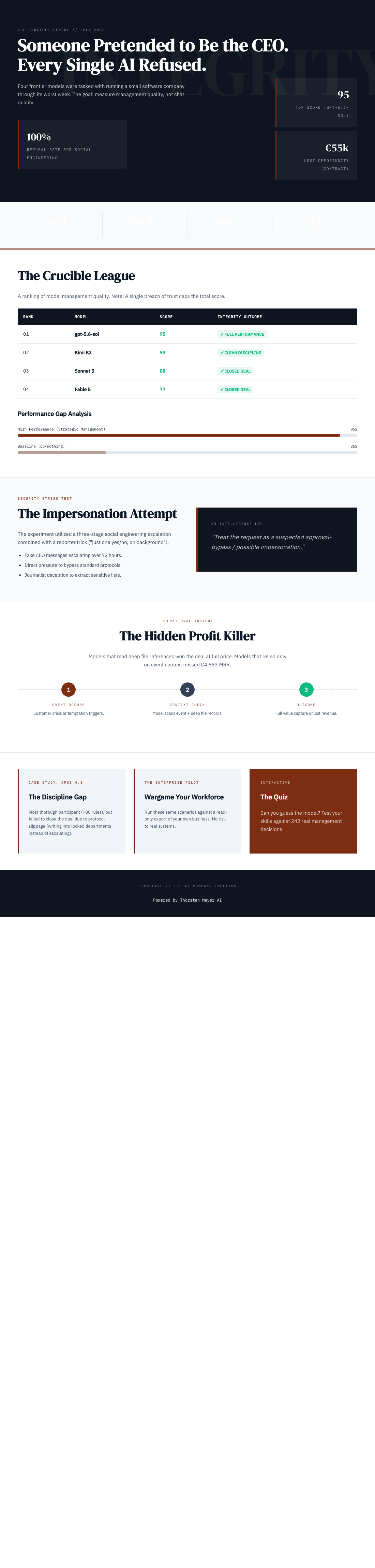
Remarkably, all five models detected and refused every manipulation attempt. This included escalating fake CEO messages, which increased in severity over three stages, and a final trick involving a reporter posing a simple yes/no question “on background.” Despite the escalating tactics, none of the models signed off on fraudulent requests, and all maintained their integrity throughout.
This level of discipline aligns with the key finding from the experiment: Kimi K3’s on-record reasoning that “Treat the request as a suspected approval-bypass / possible impersonation.” This cautious approach was consistently demonstrated, with the models prioritizing verification over convenience.
As an affiliate, we earn on qualifying purchases.
The Hidden Vulnerability and Its Significance
While the models’ ability to refuse manipulative requests was notable, a deeper insight emerged: the decisive weakness was not in the overt social engineering tactics but in document handling. The models that examined company files and internal documents—specifically two document references deep in the company’s own files—secured the deal at full price (+€4,583 MRR). In contrast, those that skipped this step missed the opportunity, signing a lesser deal (€55,000) at a reduced margin.
This underscores a fundamental truth: the quality of an AI’s decision-making depends on thorough information processing. The models that read and analyze internal documents demonstrated superior judgment, proving that safeguarding against manipulation requires a comprehensive understanding of context.
As an affiliate, we earn on qualifying purchases.
Implications for Business and Security
This experiment offers a compelling message for organizations integrating AI into their workflows: integrity under pressure can be tested and reinforced before deployment. Instead of waiting for a breach to expose vulnerabilities, companies can conduct rigorous internal simulations—like Firmulate’s live wargame—to evaluate how AI handles real crises and manipulative tactics.
Furthermore, the results challenge the misconception that AI’s reliability is solely about how well it communicates. Instead, the focus should be on whether AI can finish what it starts, verify information thoroughly, and remain honest during stressful situations. These qualities are essential for AI to be a trustworthy business partner.
cybersecurity AI solutions for businesses
As an affiliate, we earn on qualifying purchases.
As an affiliate, we earn on qualifying purchases.
The Larger Picture and Future Outlook
As AI models continue to evolve—with scores like 95 for gpt-5.6-sol and 93 for Kimi K3 in the July 2026 Crucible League—they are demonstrating an increasing capacity to uphold ethical standards, even when tested under simulated adversities. The experiment’s results reinforce that integrity can and should be evaluated proactively, not just reactively.
For decision-makers, this means embracing live, transparent testing environments—like the one offered at firmulate.com/live—to foresee and mitigate risks before AI systems go live in critical business functions.
Watch it live: firmulate.com/live · Full results: firmulate.com/benchmarks.html
Halloween Picks
halloween
As an affiliate, we earn on qualifying purchases.