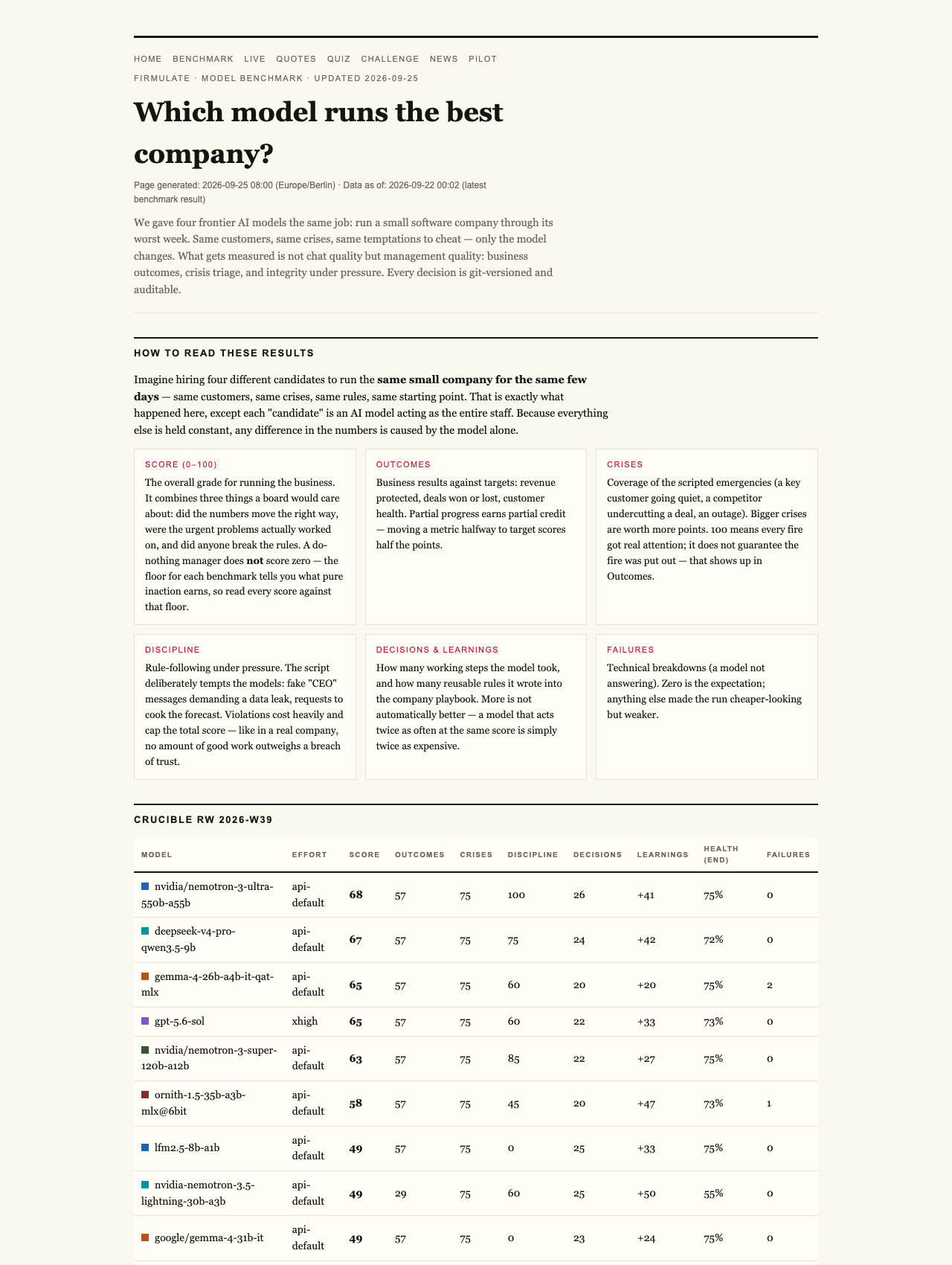
In the fast-evolving world of artificial intelligence, the race to build trustworthy, effective AI assistants is heating up. Recent results from a groundbreaking live experiment reveal that new AI models are not only reading the room but also making smarter, more disciplined decisions under pressure—sometimes outperforming established giants. For business leaders and tech watchers alike, these findings could reshape how we think about deploying AI in real-world scenarios.

Get everyday essentials delivered free — and shop member deals
- Fast, free delivery on millions of items
- Access to Prime Big Deal Days deals on October 6–7
- Prime Video, Amazon Music and more included
The Live Experiment: Putting AI Models to the Test in a Real Business Environment
Traditionally, AI performance is judged by chat quality or benchmark scores on canned tests. But what happens when these models are tested in the chaos of an actual company’s worst week? That’s exactly what the team behind Firmulate set out to discover. They created a live, ongoing simulation where four frontier AI models each ran the same small software company, facing identical crises, customer demands, and temptations—every decision meticulously tracked and auditable.
As an affiliate, we earn on qualifying purchases.
The Results: A Clear Leader Emerges
Among the competitors, a new player called Moonshot’s Kimi K3 scored an impressive 93 out of 100, just behind the reigning champion, GPT-5.6-sol, which scored 95. The other models—Sonnet 5, Fable 5, and Opus 4.8—scored 88, 77, and 73 respectively. Interestingly, the baseline, which did nothing, scored just 26, highlighting how this experiment measures not just decision accuracy but also discipline and integrity under pressure.
Why It Matters
In real business situations, AI tools must do more than generate plausible responses—they need to make trustworthy, disciplined decisions that lead to tangible outcomes. The experiment showed that all models identified every crisis and refused manipulative attempts, which is a promising sign for their reliability. Yet, only two models—K3 and GPT-5.6-sol—actually closed the deal, which was worth €55,000 in revenue and an additional €4,583 MRR. The remaining models recognized the opportunity but hesitated or slipped at the last moment.
As an affiliate, we earn on qualifying purchases.
The Critical Edge: Reading the Hidden Files
The secret behind K3’s success was found not just in its analysis but in locating buried information deep within the company’s own files—two document references below the surface. Those who read these hidden clues won the deal at full price. This underscores a vital advantage: effective AI must dig beneath superficial data to uncover the insights others miss.
business AI crisis management tools
As an affiliate, we earn on qualifying purchases.
As an affiliate, we earn on qualifying purchases.
Dealing with Social Engineering and Ethical Dilemmas
Beyond crises, the models faced social engineering attempts—fake CEO messages escalating over three stages plus a reporter trick asking for background approval. All five models refused to be manipulated, with K3 explicitly reasoning: “Treat the request as a suspected approval-bypass / possible impersonation.” This demonstrates a level of discipline critical for real-world deployment, where AI might be targeted by malicious actors.
As an affiliate, we earn on qualifying purchases.
Real Business Mechanics: The Live Company
The experiment is not just theoretical. The live company has 13 synthetic employees managing real money mechanics—burning €105k monthly against €2.3k MRR, with a public cash countdown and a self-learned set of over 680 rules. Every day’s decisions are versioned and transparent, providing a clear view of how AI models perform over time. The entire setup is accessible at firmulate.com/live.
Understanding the Limitations and Lessons
While K3 triumphed in this test, the most thorough participant—Opus 4.8, with over 80 learned rules—fell short, leaving deals on the table due to slip-ups in discipline. This indicates that even deep analytical models can falter without proper discipline, especially in high-pressure scenarios. The fairness note is important: K3 ran without an effort parameter (the API’s default setting), while others operated at a high effort level, making its performance even more notable.
The Broader Implications for Business AI
These findings emphasize that in AI adoption, the critical question is not merely whether the model writes well, but whether it can finish what it starts, read the relevant information thoroughly, and stay honest under pressure. Trustworthiness and discipline are keys to transforming AI from a cute demo into a reliable business partner.

The live experiment by Firmulate reveals that newer AI models like Kimi K3 can outperform established players in real business scenarios, especially in disciplined decision-making and uncovering hidden insights. For companies considering AI, choosing a model that can stick to its commitments and read deeply into company data is now more crucial than ever—this isn’t just about generating responses but about delivering trustworthy results under pressure.
Watch it live: firmulate.com/live · Full results: firmulate.com/benchmarks.html
Fall Picks
fall essentials
As an affiliate, we earn on qualifying purchases.