TL;DR
A manifesto published November 16 by European game-union members urges employers to avoid generative AI, workers to avoid using it where possible, and players to support games made without it. The unions cite concerns about working conditions, consent for training data and effects on game development; studios’ responses to the manifesto were not publicly known at the time of the source report.
The manifesto was published by IWGB Game Workers, with contributions described as being in collaboration with members of Game Workers Unite Ireland, CSVI of Spain and the FIOM-CGIL Milan Work Council. Rock Paper Shotgun and Kotaku also identify France’s STJV and Germany’s GDRT as participants, bringing the reported total to six unions. The source material does not state how many workers the groups represent.

Get everyday essentials delivered free with Prime
- Fast, free delivery on millions of items
- Prime Video, Amazon Music and more included
- Member-only deals all year
The document addresses both material players see, including art, sound, code and dialogue, and behind-the-scenes work such as concept art, reference materials and pre-translation. It asks workers to avoid generative AI services where possible and negotiate company agreements. For employers, it calls for avoiding the technology entirely, making sure no worker is required to use it, and precisely labeling any use that cannot be avoided.
For players, the unions recommend supporting games made without generative AI and publicly expressing that preference. Their recommendations for regulators include barring the use of people’s work in AI training data without consent and fair compensation, and allowing workers to withdraw their work. The manifesto’s central position is that workers should decide when and how the tools are used.
A Labor Dispute With Industry Reach
The demands reach beyond whether AI-generated material appears in a finished game. By including early development and internal materials, the unions’ position would apply to tools used in production even when players never see the output. That could affect studio workflows, staff agreements and what companies disclose about development.
The argument also intersects with wider disputes over job security, training data and consent. The manifesto says generative AI is replacing workers and reducing junior opportunities; these are claims made by the unions, not findings established by the document itself. The source report says it found no public response from a studio or trade body to the manifesto by publication time, leaving the extent of any immediate business impact unclear.
Popular right now

Samsung 55-Inch QN70H Neo QLED 4K Smart TV (2026)

De’Longhi Rivelia Fully Automatic Espresso Machine with Grinder and Milk Frother, Beige

Vitamix 5200 Professional-Grade Blender with 64 oz Container, Black
As an affiliate, we earn on qualifying purchases.
A Debate Already Underway
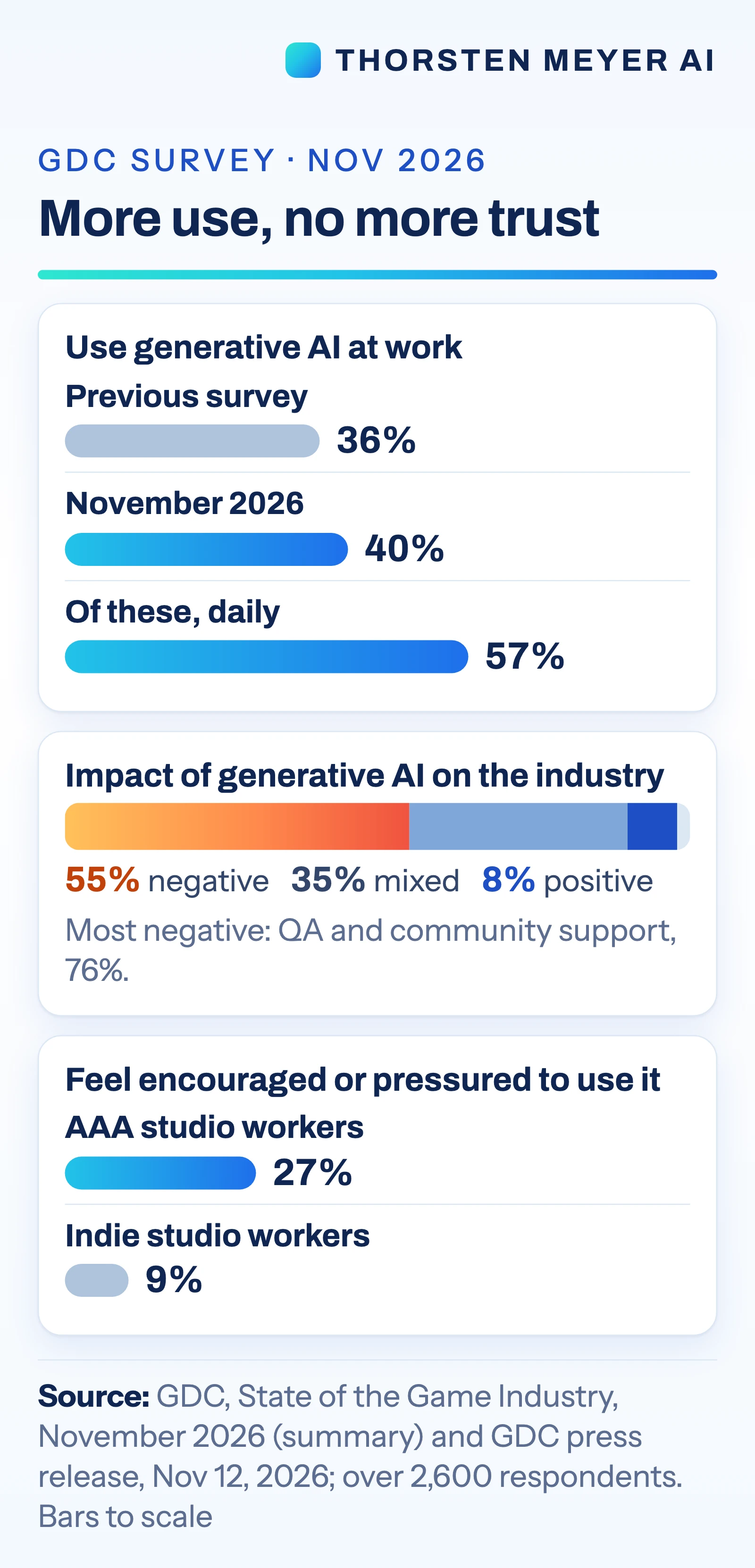
The manifesto appeared amid growing use of generative AI in game work and concern among professionals about its effects. A Game Developers Conference survey published November 12 found that 40% of respondents used generative AI at work, up from 36% in the prior comparison reported by the source. The survey also found that 55% thought the technology was hurting the industry. These figures describe surveyed professionals, not all game workers.
Other developments that week reflected divisions over use. The source says a group of Independent Games Festival jurors said they would not vote for games using generative AI “in any capacity.” The studio behind Big Walk, meanwhile, disclosed that large language models touched “well under 0.1%” of its code. In 2024, European trade body Video Games Europe said generative AI was widely expected to advance game development and argued against AI labels in games. On November 12, Xbox CEO Asha Sharma wrote that small teams could build worlds that currently require hundreds of developers, without naming AI.
““Games are best made by people.””
— The manifesto’s authors
Responses And Effects Remain Unknown
The source report found no public response from a studio or trade body to the manifesto at the time it was written. It is not clear whether any companies will change their AI policies, negotiate agreements with workers or adopt the requested labeling practices. The number of workers represented by the unions involved is also not specified.
The unions link generative AI to job losses and fewer junior roles, but the available material does not establish that AI caused any particular layoffs. The GDC survey reported that 34% of respondents had been laid off in the previous two years; it does not, in the supplied account, connect those layoffs to AI. Legal questions about the use of copyrighted work in training datasets remain contested, according to the source report.
Company Policies And Worker Agreements
The next developments to watch are responses from game studios, industry bodies and regulators, along with any workplace agreements negotiated under the manifesto’s recommendations. Those steps would show whether the document changes company policy or remains a statement of union demands.
Further reporting may also clarify how many workers the participating unions represent and whether employers adopt disclosure rules for generative AI used in development. Until then, the manifesto sets out the groups’ position, but does not establish that studios or regulators will follow it.
Key Questions
Who published the generative AI manifesto?
IWGB Game Workers published it on November 16, 2026. The source says members of several other European game-worker groups collaborated; other outlets cited in the source identify six unions in all.
What does the manifesto ask game studios to do?
It urges employers to avoid generative AI entirely, not require workers to use it and precisely label any use that cannot be avoided.
Does the manifesto cover AI used behind the scenes?
Yes. It addresses development materials such as concept art, references and pre-translations, as well as assets that appear in the finished game.
What remains unknown about the manifesto’s impact?
The source report did not identify a public studio or trade-body response. It is not yet clear whether companies will change policy, how many workers the unions represent or whether AI contributed to specific layoffs.
Source: Thorsten Meyer AI