
TL;DR

Get everyday essentials delivered free — and shop member deals
- Fast, free delivery on millions of items
- Access to Prime Big Deal Days deals on October 6–7
- Prime Video, Amazon Music and more included
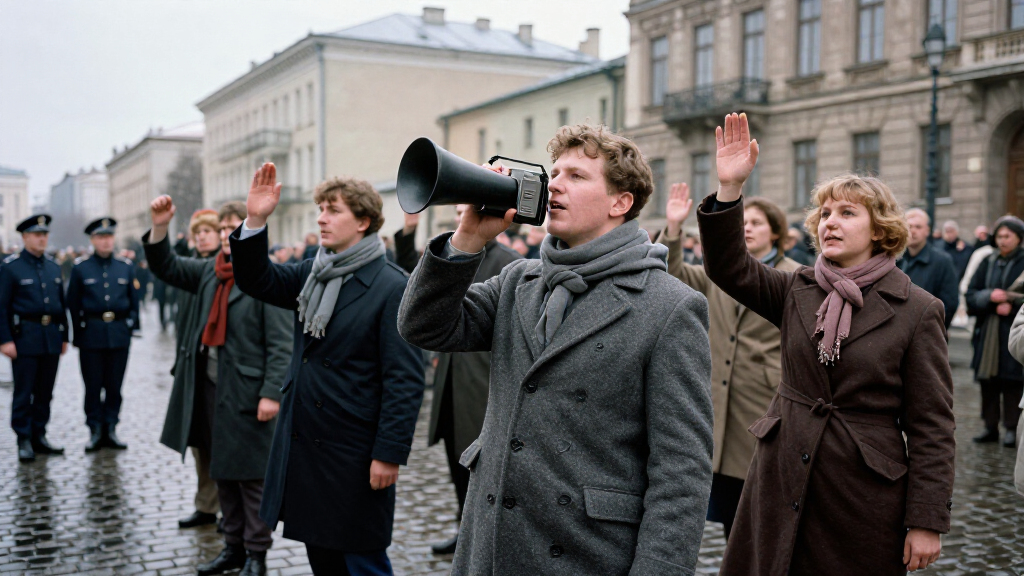
On Dec. 5, 1965, several dozen people gathered in Moscow’s Pushkin Square to demand an open trial for writers Andrei Sinyavsky and Yuli Daniel, appealing to rights in the Soviet Constitution. The rally lasted only minutes before authorities dispersed it, but its public appeal to the law became an early landmark of the Soviet dissident movement. The account is a historical retrospective published by Meduza, not a report of a new protest.
Several dozen people gathered in Moscow’s Pushkin Square in December 1965 to demand an open trial for writers Andrei Sinyavsky and Yuli Daniel, making a brief public appeal to the Soviet government to follow its own laws. Authorities dispersed the rally within minutes, but the protest’s insistence on citizens’ constitutional rights helped mark the start of an organized Soviet human rights movement, according to a historical retrospective by Meduza.
The demonstration was organized by Alexander Volpin, a mathematician and poet who wanted to remind officials publicly that citizens had a right to an open trial. The participants did not call for a change of government or broader political reforms. Their demand focused on the handling of the case against Sinyavsky and Daniel, writers whose trial was taking place behind closed doors.
Meduza reports that the gathering lasted only a few minutes before authorities broke it up. Soviet newspapers gave the protest almost no coverage. Its importance, the retrospective argues, lay less in its size or immediate effect than in the method it made visible: publicly citing existing Soviet law to challenge the state’s conduct, rather than calling for a direct political confrontation.
The writers had published fiction abroad under pseudonyms because their work could not pass Soviet censorship. Sinyavsky wrote as Abram Tertz and Daniel as Nikolai Arzhak. Their trial became a major post-Stalin-era case involving writers, and the protest connected opposition to the proceedings with a broader demand for legal rights. The supplied account does not state how many people were arrested or identify any immediate legal outcome from the rally.
A Legal Demand in Public
The protest mattered because it framed dissent as a demand that the government honor rules it claimed to uphold. Rather than setting out a program to replace the Soviet system, participants used its own constitutional language to challenge the secrecy of a trial. That approach gave the gathering a specific legal focus and made the state’s response part of the argument.
Its small scale should not obscure the risk of public assembly in the period. Meduza’s account places the rally against a history in which independent demonstrations had been suppressed and information about state violence restricted. The 1965 event did not itself bring an open trial or broad reform, according to the supplied material. Its longer-term importance is that it helped make visible a form of civic protest centered on public accountability and legal rights.
As an affiliate, we earn on qualifying purchases.
From the Thaw to Pushkin Square
After Stalin’s death, the Soviet cultural climate eased in some respects, and young people created informal spaces for discussion and poetry readings. One such gathering place was near the Mayakovsky monument in Moscow. But this limited opening did not amount to a right to protest. The 1962 Novocherkassk workers’ demonstration, prompted by rising prices and wage cuts, was met with gunfire; the authorities kept information about the killings secret and held closed trials.
In January 1965, young poets formed SMOG, a literary group that held readings and circulated uncensored writing. Authorities responded with pressure, including expulsions from universities and the removal of some members from Moscow, Meduza reports. In the same period, Sinyavsky and Daniel’s case tested the limits of post-Stalin cultural tolerance. Volpin’s rally emerged from that clash: it was a short, narrowly framed protest in a country where independent public demonstrations had been suppressed for decades.
Meduza traces that record back to the Bolsheviks’ early years, citing the deadly suppression of a peaceful 1918 demonstration in support of the Constituent Assembly and the breakup of opposition marches in 1927. By the late 1920s, unauthorized protests had largely disappeared from political life. The 1965 gathering was therefore unusual not because it was large, but because people publicly assembled to make a claim against the state.
“They sought neither a change of government nor political reforms.”
— Meduza’s retrospective
1960s political activism documentary
As an affiliate, we earn on qualifying purchases.
As an affiliate, we earn on qualifying purchases.
What the Record Leaves Open
The supplied account does not give a precise participant count beyond several dozen, list everyone who attended, or detail arrests and other individual consequences of the rally. It also does not establish that the demonstration directly changed the conduct or outcome of the Sinyavsky–Daniel proceedings. Meduza presents the event as helping launch the dissident movement; that is a historical interpretation of its significance, not a claim that one brief gathering alone created the movement.
The article is a retrospective, originally published in Russian in December 2025 and republished in English in October 2026. No new archival findings or contemporary developments are identified in the supplied material.
As an affiliate, we earn on qualifying purchases.
A Historical Account, Not a New Event
There is no forthcoming decision or event attached to this historical episode in the supplied report. The immediate next step for readers seeking a fuller account is the complete Meduza retrospective, which continues with details about the Sinyavsky–Daniel case and the protest’s origins. Any further claims about individual arrests, trial outcomes, or the later activities of participants would need to be checked against additional sources.
Soviet dissident movement memorabilia
As an affiliate, we earn on qualifying purchases.
As an affiliate, we earn on qualifying purchases.
Key Questions
What happened in Pushkin Square in 1965?
Several dozen people gathered in Moscow to demand an open trial for writers Andrei Sinyavsky and Yuli Daniel. Authorities dispersed the protest within minutes.
Who organized the demonstration?
Meduza identifies Alexander Volpin, a mathematician and poet, as the organizer. He wanted to call attention publicly to citizens’ right to an open trial.
Were protesters calling for the Soviet government to be replaced?
No. According to Meduza, they did not demand a change of government or political reforms. Their stated focus was the government’s obligation to obey its own laws and hold an open trial.
Why is the protest considered significant?
The retrospective says the gathering helped launch the Soviet dissident movement by making a public legal challenge to the state. Its significance was its method and message, not its size or an immediate policy change.
When was the report published?
Meduza says the article was originally published in Russian in December 2025 and appeared in English on October 7, 2026. It looks back at the December 1965 protest.
Source: rss
Fall Picks
fall essentials
As an affiliate, we earn on qualifying purchases.