
By 2025, you’ll see quantum computing move from experimental to practical use, revolutionizing industries like cryptography, drug discovery, and materials science. Breakthroughs in hardware and error correction will give you more reliable, scalable quantum systems capable of tackling complex problems faster and more accurately. As these advancements progress, quantum tech will become more integrated into everyday applications. Keep exploring, and you’ll discover how these innovations are shaping the future of technology.
Key Takeaways
- Quantum hardware development is rapidly advancing, aiming for scalable, reliable systems by 2025.
- Enhanced error correction techniques will enable more stable and accurate quantum computations.
- Increased qubit coherence and stability will allow tackling complex real-world problems effectively.
- Quantum applications in cryptography, material science, and optimization are expected to become practically viable.
- Industry adoption and integration of quantum computing will accelerate, transforming multiple sectors by 2025.
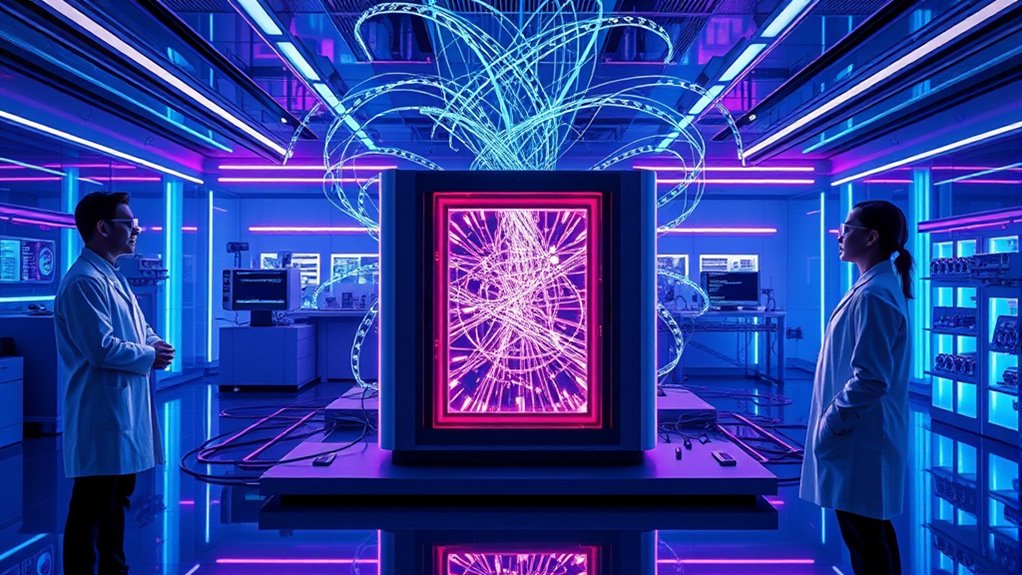
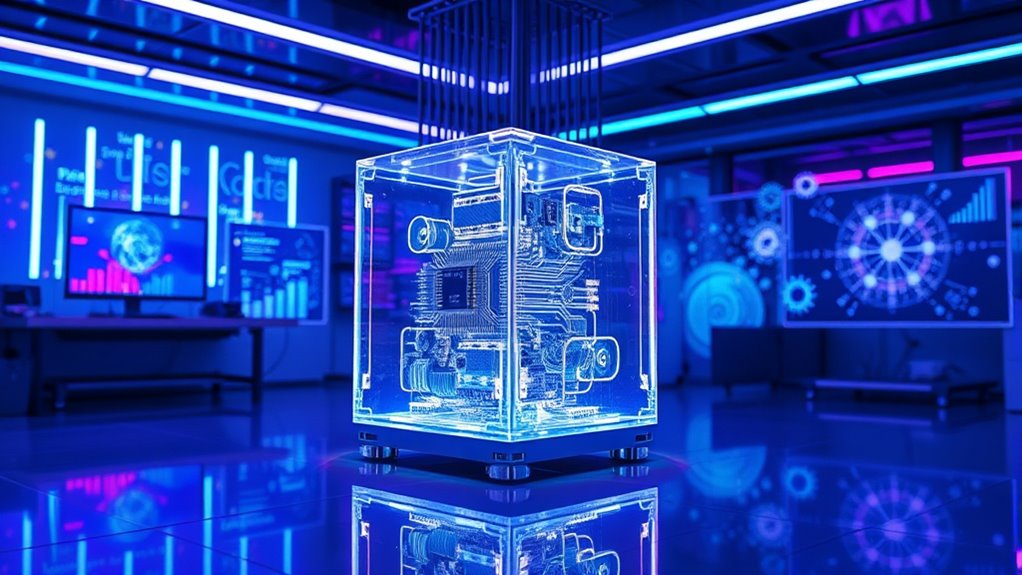
By 2025, quantum computing is poised to shift from experimental research to practical applications that could revolutionize industries. At the heart of this transformation lies the rapid development of quantum hardware, which is indispensable for building reliable, scalable quantum computers. Unlike classical hardware, quantum hardware uses qubits that can exist in multiple states simultaneously, enabling unprecedented processing power. However, maintaining the delicate quantum states of these qubits remains a significant challenge. Environmental noise and operational errors threaten to disrupt computations, making error correction techniques essential for progress. You’ll find that researchers are making strides in designing robust quantum hardware that minimizes these errors, ensuring the qubits can sustain coherence longer and perform complex calculations more accurately.
Error correction, in particular, has become a focal point of development. Unlike classical error correction, which is straightforward due to binary states, quantum error correction must address the superposition and entanglement of qubits. You’ll notice that advanced error correction codes are being integrated into quantum systems, allowing them to detect and correct errors on the fly. This capability is indispensable because it transforms fragile quantum states into resilient computational resources. As a result, quantum hardware becomes more reliable and scalable, paving the way for real-world applications. The ongoing improvements in error correction techniques are enabling quantum computers to operate with increased fidelity, reducing the number of errors that can derail complex algorithms. Additionally, progress in quantum hardware reliability is critical for achieving the scalability needed for widespread use.
Furthermore, the evolution of quantum hardware and error correction directly impacts the pace at which quantum computers can solve real problems. You can expect these innovations to lead to more stable and powerful quantum systems capable of tackling optimization problems, material simulations, and cryptography tasks that are currently infeasible with classical computers. Quantum hardware advancements are also making it easier to integrate quantum processors into existing technological environments, accelerating their adoption across industries. As error correction becomes more sophisticated, the barrier of qubit instability diminishes, and you’ll see quantum computers tackling larger problems with higher accuracy.
Frequently Asked Questions
How Will Quantum Computing Impact Everyday Consumer Devices by 2025?
By 2025, quantum computing will revolutionize your everyday devices through enhanced quantum security, protecting your data from cyber threats. Consumer integration will make quantum-powered features more accessible, improving device performance, AI capabilities, and personalized experiences. You’ll notice faster processing, smarter apps, and more secure transactions. This technology will seamlessly blend into your daily life, making your devices more efficient, secure, and intelligent, transforming how you interact with technology every day.
What Industries Will Benefit Most From Quantum Advancements in 2025?
You’ll see industries like cybersecurity and pharmaceuticals benefit most from quantum advancements in 2025. Cryptography advancements will make data security more robust, protecting your information better than ever. Meanwhile, drug discovery will accelerate as quantum computing models complex molecules faster, leading to groundbreaking treatments. These innovations will transform how you interact with secure data and healthcare, making processes more efficient, safer, and personalized in the near future.
Are There Ethical Concerns Associated With Quantum Computing Breakthroughs?
Like a double-edged sword, quantum computing brings both promise and peril. You should be aware that ethical concerns, especially around data privacy and security risks, are significant. As breakthroughs occur, encrypted data could be vulnerable, exposing personal and sensitive information. You must consider responsible development, ensuring safeguards are in place. Embracing these advancements requires balancing innovation with ethical responsibility to prevent misuse and protect individual rights.
How Accessible Will Quantum Technology Be to Startups and Small Companies?
Quantum accessibility will improve by 2025, making it easier for startups and small companies to adopt. You’ll find more cloud-based quantum services, reducing the need for costly hardware investments. As a result, startup adoption of quantum technology will increase, enabling innovative solutions across industries. While challenges remain, the trend points toward broader access, empowering smaller firms to leverage quantum breakthroughs without needing extensive resources.
What Are the Main Challenges in Maintaining Quantum Coherence at Scale?
You face significant challenges in maintaining quantum coherence at scale, primarily due to environmental stability issues and error correction needs. Environmental disturbances, like temperature fluctuations and electromagnetic interference, can disrupt qubits, causing decoherence. To combat this, you must implement advanced error correction techniques and create highly controlled environments. Achieving long-lasting coherence requires balancing these factors, making scalability complex but essential for practical quantum computing applications.
Conclusion
By 2025, you’ll witness quantum computing transforming industries, revolutionizing research, and redefining possibilities. You’ll see breakthroughs that challenge limits, applications that solve complex problems, and innovations that inspire new ideas. You’ll embrace a future where quantum enhances security, accelerates discovery, and expands horizons. This era of quantum progress invites you to explore, adapt, and innovate—because the quantum revolution isn’t just coming; it’s already here, reshaping your world in ways you’ll never forget.