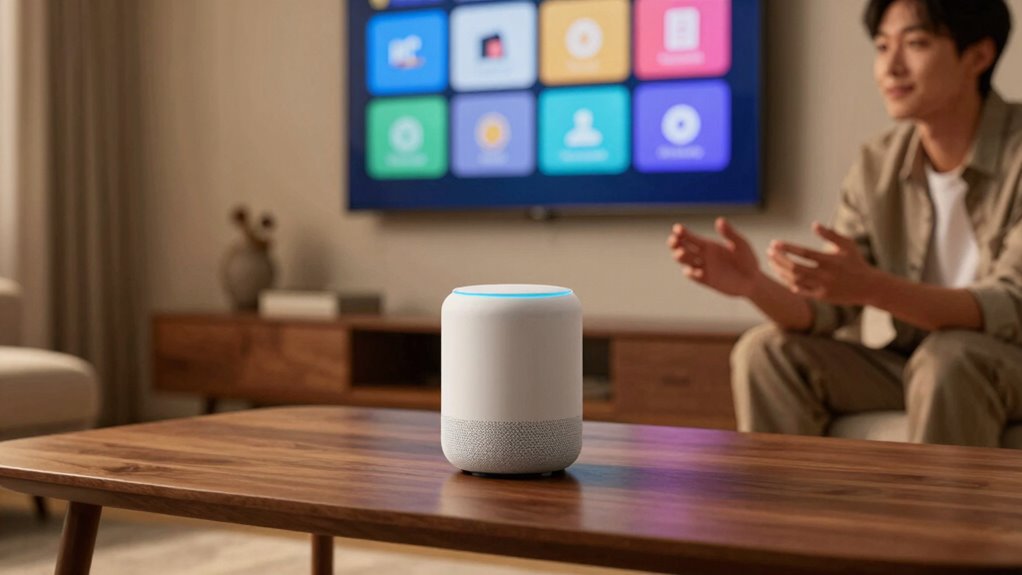
In 2026, voice interfaces are essential because they seamlessly blend into your daily routines, making interactions more natural and effortless. They power everything from household appliances to workplace tools, allowing you to control lighting, manage schedules, and retrieve complex information easily. Advanced AI understands your preferences and context, responding conversationally and accurately. With built-in privacy safeguards and security measures, they build your trust. Stay with us to discover how these innovations continue shaping your connected life.

Get everyday essentials delivered free with Prime
- Fast, free delivery on millions of items
- Prime Video, Amazon Music and more included
- Member-only deals all year
Key Takeaways
- Voice interfaces enable seamless, natural interactions across diverse devices and environments, enhancing user convenience and accessibility.
- Advances in AI improve contextual understanding, making voice commands faster, more accurate, and tailored to user preferences.
- Privacy safeguards and local processing build user trust and ensure secure, responsible use of voice technology.
- Integration into daily life with smart appliances and tools makes voice interfaces indispensable for routine tasks.
- Continuous innovation in responsiveness and security maintains voice interfaces as essential in the connected world of 2026.

By 2026, voice interfaces have become seamlessly integrated into daily life, transforming how you interact with technology. No longer confined to smartphones or smart speakers, they now power everything from household appliances to workplace tools, making communication more natural and intuitive. This widespread adoption hinges on advanced AI integration, which allows these systems to understand context, interpret nuances, and respond more conversationally. You can ask your voice assistant to schedule meetings, control your home’s lighting, or pull up complex information without fumbling through screens or menus. The AI’s ability to learn from your habits and preferences enhances your experience, making interactions feel personalized and effortless.
Voice interfaces in 2026 seamlessly integrate into daily life, making interactions natural, intuitive, and personalized across devices and environments.
However, with this convenience comes a critical concern: user privacy. As voice interfaces gather vast amounts of data to improve their performance, you’re right to worry about how your information is being handled. Companies have made strides in implementing privacy safeguards, such as anonymizing data and giving you more control over what’s stored. You can now easily review and delete voice recordings or adjust privacy settings to limit data sharing. Despite these measures, the risk of breaches or misuse remains, emphasizing the importance of transparency and robust security. You want to trust that your voice commands aren’t being exploited or used beyond their intended purpose.
The ongoing AI integration in voice interfaces also helps address privacy challenges. Smarter algorithms can process commands locally on your device, reducing the amount of data sent to cloud servers. This shift toward edge computing means your voice data stays closer to you, lowering the risk of interception or unauthorized access. Additionally, developers are embedding privacy-preserving techniques like federated learning, which allows models to improve without exposing individual data. This technological evolution reassures you that convenience doesn’t have to come at the expense of security. You can enjoy the benefits of voice interfaces—like hands-free control and faster information retrieval—while maintaining control over your personal data. Furthermore, ongoing advancements in privacy-preserving techniques ensure that user trust remains central to voice technology development. As these systems become more sophisticated, they also incorporate security measures designed to protect your data from malicious threats. In addition, the integration of cultural and regional considerations helps tailor voice interfaces to diverse user needs and privacy expectations across different communities.
In 2026, voice interfaces remain relevant because they strike a balance between AI integration and user privacy. They evolve to understand you better, becoming more natural and responsive. Simultaneously, the industry recognizes privacy as a fundamental component, implementing safeguards that align with your expectations. This combination ensures that voice interfaces continue to enhance your daily routines without compromising your security or trust. As these technologies mature, they’ll keep offering the seamless, personalized, and privacy-conscious experience you’ve come to rely on, proving their importance in your connected world.
Popular right now

KitchenAid 5.5-Quart Bowl-Lift Stand Mixer, Porcelain White

Roborock Q10 S5+ Robot Vacuum and Mop with Self-Emptying Station, 10,000 Pa Suction

Vitamix 5200 Blender with 64 oz. Container, Black
As an affiliate, we earn on qualifying purchases.
Frequently Asked Questions
How Secure Are Voice Interfaces Against Hacking?
Voice interfaces can be quite secure if they use voice authentication, which verifies your identity through unique voice patterns. However, they’re still vulnerable to hacking if data encryption isn’t robust. You should guarantee your device employs strong encryption methods to protect your voice data. While no system is completely hack-proof, combining voice authentication with advanced encryption greatly reduces risks and keeps your information safer.
Can Voice Interfaces Understand Multiple Languages Simultaneously?
Yes, voice interfaces can understand multiple languages simultaneously, thanks to advancements in multilingual detection and accent recognition. These technologies enable you to switch effortlessly between languages or even speak multiple languages in a single command. Developers continuously improve these features, making it easier for you to communicate naturally. As a result, voice interfaces become more versatile and accessible, enhancing your overall experience regardless of your language or accent.
What Are the Privacy Concerns With Always-On Voice Devices?
You should be aware that always-on voice devices raise privacy concerns because they continuously listen for commands. Data encryption helps protect your recordings from unauthorized access, but vulnerabilities still exist. User authentication, like voice recognition, aims to guarantee only authorized users access sensitive information. However, if these security measures fail or aren’t implemented properly, your personal conversations could be exposed or misused, making privacy a critical consideration.
How Do Voice Interfaces Adapt to Different Accents?
You might notice that voice interfaces adapt through advanced accent recognition and handling pronunciation variations, making interactions smoother. They analyze speech patterns, learn from diverse pronunciations, and fine-tune responses accordingly. This ongoing evolution guarantees your unique accent isn’t a barrier but a bridge, allowing you to communicate effortlessly. As technology progresses, voice interfaces will become more inclusive, recognizing the rich tapestry of accents and making every voice heard with clarity and respect.
Will Voice Interfaces Replace Traditional User Interfaces Entirely?
Voice interfaces likely won’t replace traditional user interfaces entirely, but they’ll complement them through features like gesture recognition and visual feedback. You’ll find yourself switching seamlessly between voice commands and touch or visual controls, depending on your environment or task. This hybrid approach enhances accessibility and efficiency, making interactions more intuitive. As technology advances, your experience becomes more personalized, blending voice, gestures, and visuals for a smoother, more natural user interface.
Conclusion
In 2026, voice interfaces are like the trusted co-pilot guiding you through a busy sky—essential and intuitive. Remember that time you effortlessly ordered dinner while juggling calls? That’s the power of voice: seamless, natural, and always there when you need it. As technology evolves, ignoring this voice-driven shift is like refusing to upgrade your wings—you might still fly, but you’ll miss the smooth, effortless journey everyone else is enjoying.