
TL;DR

Get everyday essentials delivered free with Prime
- Fast, free delivery on millions of items
- Prime Video, Amazon Music and more included
- Member-only deals all year
Anthropic’s $65 billion Series H round pushes its valuation past $965 billion, but the real story is about investing in massive compute capacity. Revenue is soaring, and this signals a new era where compute is king in AI’s growth story.
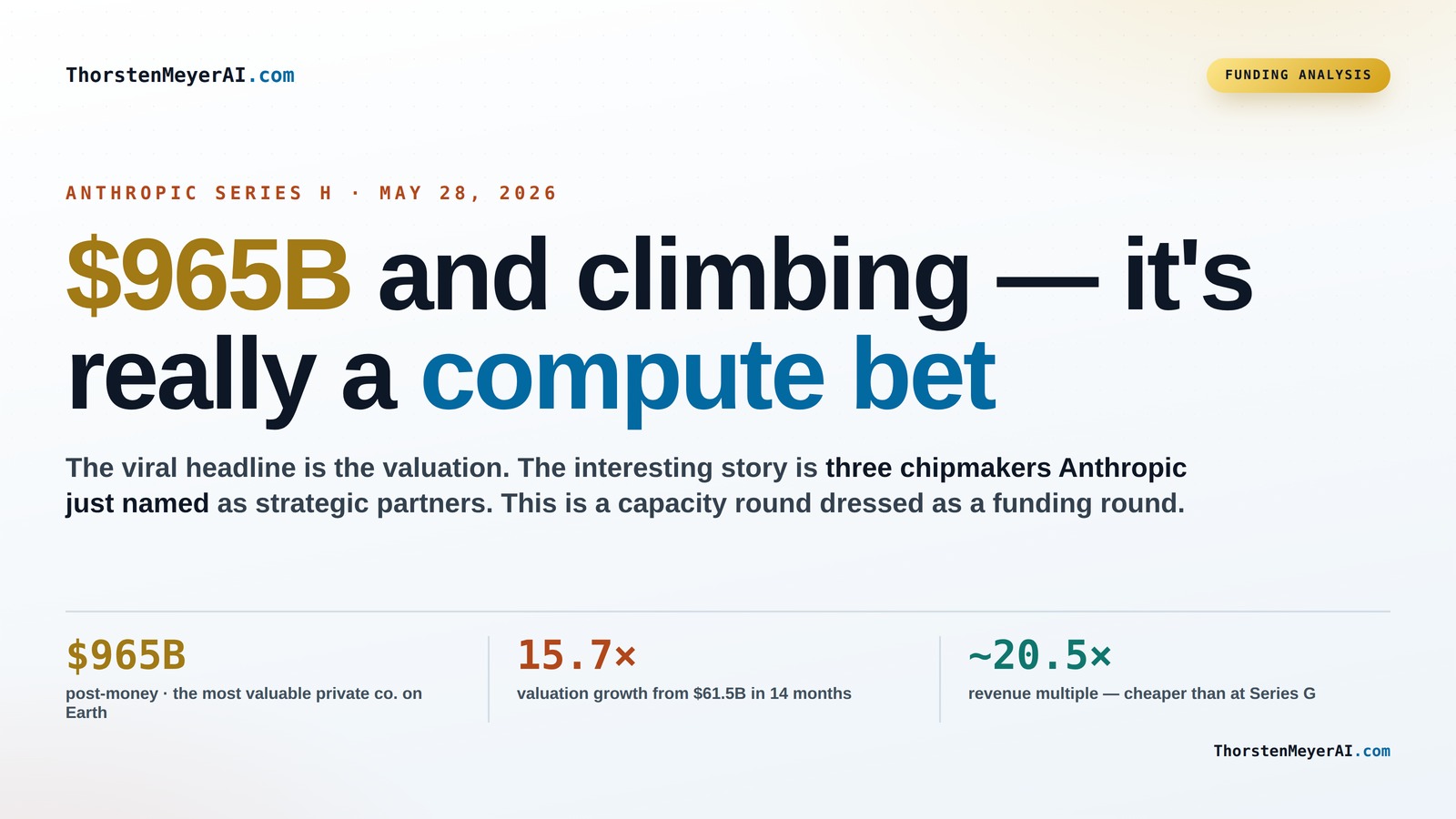
$965B and climbing — it’s really a compute bet
The viral headline is the valuation. The interesting story is in the press release’s middle paragraphs — and in three chipmakers Anthropic just named as strategic partners. This is a capacity round dressed as a funding round.
The numbers nobody can quite parse in sequence
Read together they describe a trajectory with no precedent in enterprise software. Read individually, each looks like a typo.
From $61.5B to $965B in fourteen months
Salesforce took roughly two decades to reach revenue numbers Anthropic just blew past. The sequence below is the part most coverage skips — it’s not the size, it’s the shape.
Anthropic’s valuation ladder · Mar 2025 → May 2026
Five rounds, fourteen months. Bar height is the valuation; the climb itself is the story. Tap any milestone for context.
The multiple actually got cheaper
Bubbles look like multiples expanding while revenue lags. Anthropic’s pattern is the inverse — the valuation tripled, but revenue grew faster, and the multiple compressed.
Revenue-to-valuation multiple · Series G → Series H
Same company, three months apart. The denominator (revenue) is outrunning the numerator (valuation) — exactly the opposite of what a bubble narrative predicts.
10+ gigawatts and three chipmakers
When you name Micron, Samsung & SK hynix alongside your equity backers, you’re saying the binding constraint isn’t demand or model quality — it’s the physical supply of memory chips. The Series H is a capacity round.
Compute commitments backing Anthropic’s capacity bet
$200B+ in announced compute spend across multi-year contracts. The $65B Series H raise has to be read against that bill, not against operating losses.
A genuinely durable bet — or a structural exposure?
Both readings can be true at once. The answer arrives over the next 18–24 months as the gigawatts come online and either fill with paying demand or don’t.
Revenue growth has no precedent in B2B software ($1B → $47B in 17 months). The multiple is compressing, not expanding. Claude is the only frontier model on all 3 major clouds. Enterprise AI spend share went from ~10% to >65% in a year. Compute commitments are tied to specific contracts with capacity dates.
20× revenue is not cheap by any historical software-investing standard. Revenue is reported gross of cloud-reseller pass-throughs, which inflates the top line. Profitability is 2 years out. Amodei’s own warning: a 12-month delay in AI progress “would make him bankrupt” — the compute commitments are a structural exposure to demand persistence.
The valuation race — and the IPO context
Anthropic shipped Opus 4.8 the same morning as Series H — not a coincidence. One week after OpenAI filed confidentially for IPO. The late-2026 frame is set: two frontier AI companies racing to public markets, each pitching durability.
Key Takeaways
- Anthropic’s $965 billion valuation is driven more by hardware capacity investments than current revenue levels.
- The $65 billion raise is primarily about expanding compute infrastructure, not just company valuation.
- Rapid revenue growth (over 3× in four months) is actually lowering the valuation multiple, indicating healthy scaling.
- Major chipmakers are now strategic partners, making hardware the new currency of AI dominance.
- Future AI performance hinges on capacity expansion, making compute investments more critical than ever.
As an affiliate, we earn on qualifying purchases.
Why a $965 Billion Valuation Is Less About Money and More About Power
Anthropic’s staggering valuation isn’t just a number; it’s a statement. It signals confidence that the company will dominate AI’s future landscape. But what matters more is that this valuation is built on a foundation of huge compute commitments. In fact, most of the money raised is being funneled into expanding hardware capacity, not just company growth.
Imagine a city planning a new subway line. The real value isn’t just in the ticket sales; it’s in the tunnels and trains that will carry millions. Similarly, Anthropic’s valuation reflects the massive infrastructure needed to train and serve gigantic models like Claude at scale. This shift toward infrastructure focus indicates that the future of AI isn’t just about the software or algorithms but heavily relies on the hardware that makes these models feasible. The implications are profound: as hardware costs and capacities grow, so does the potential for more sophisticated AI, but it also introduces tradeoffs — such as increased energy consumption, cooling requirements, and the need for advanced hardware management. This underscores that the true power in AI’s future lies in hardware scalability, not just clever code.
This capacity-driven approach is a game changer, signaling that AI’s true power lies in the hardware behind the scenes. The valuation is a reflection of how much compute can be built, not just how much money is flowing in.

As an affiliate, we earn on qualifying purchases.
How Much Are They Really Spending on Compute? Let’s Break It Down
The core of this round is about compute. Anthropic committed to over 10 gigawatts of GPU and TPU capacity, with strategic partners like Micron, Samsung, and SK hynix providing the chips. Learn more about compute-heavy AI. The company has also announced more than $10 billion in compute commitments to meet skyrocketing Claude demand.
To put it simply, this isn’t a typical funding round. It’s a capacity expansion spree. The new funds will ramp up training, inference, and safety research — all powered by a massive hardware backbone. Think of it as buying dozens of supercomputers instead of just investing in product features.
For example, a single large AI model like Claude requires thousands of GPUs running in parallel, generating heat, noise, and a lot of electricity. The new investments aim to scale this infrastructure exponentially, pushing the limits of what’s technically feasible. This scaling is not without tradeoffs; increased hardware capacity means higher energy use, greater cooling demands, and more complex hardware management. These are significant challenges that could impact operational costs and environmental considerations, but they are necessary sacrifices to achieve the desired AI performance leaps. The investments reflect a strategic choice: prioritize raw capacity to unlock future AI capabilities over incremental improvements to existing hardware setups. Read more about compute-driven AI.

As an affiliate, we earn on qualifying purchases.
Revenue Growth vs. Valuation: What the Numbers Say
Here’s the surprising part: even as Anthropic’s valuation skyrocketed, its revenue growth outpaced it. In just a few months, revenue jumped from about $9 billion at the end of 2025 to over $30 billion in early April 2026 — a 3.3× increase in less than four months.
This rapid growth has actually compressed the valuation multiple from 27× down to about 20.5×, meaning revenue is growing faster than valuation. It’s the opposite of a bubble. Instead of multiples expanding as revenue lags, here revenue is pulling valuation up while multiples come down.
This pattern suggests that investors are betting on a future where expanding compute capacity will unlock even faster revenue growth — a sign that the true value is in hardware, not just the current business figures. This shift indicates a more sustainable growth trajectory, where scaling hardware infrastructure directly correlates with future revenue potential. It also reflects an understanding that the real driver of long-term value isn’t just current sales but the capacity to grow exponentially with more hardware investment. The tradeoff here is that while revenue is accelerating, the decreasing multiples highlight a cautious optimism about how quickly hardware expansion can translate into revenue gains, emphasizing the importance of capacity as a strategic asset.

As an affiliate, we earn on qualifying purchases.
What Does This Mean for the AI Market and Your Claude Experience?
More compute means better, faster AI models. It’s like upgrading from a bicycle to a rocket. For Claude users and enterprise clients, this could mean lower latency, bigger models, and more reliable service. The infrastructure investments aim to meet rising demand, especially for complex tasks like language understanding and reasoning.
On the business side, scaling compute allows Anthropic to serve more customers, handle larger workloads, and push the boundaries of AI safety and interpretability. It’s a race to see who can build the biggest, fastest AI engine — and Anthropic is betting big on hardware.
In practical terms, expect more powerful Claude versions, new features, and faster response times. All driven by the massive hardware investments funded by this historic round. The implications are significant: as hardware capacity increases, the potential for more advanced, nuanced, and reliable AI models grows. This could lead to a future where AI is not only faster but also more accurate and safe, provided the hardware investments are managed responsibly. The direct link between hardware scale and model performance underscores why capacity expansion is central to AI progress and user experience enhancement.

The Real Power Play: Infrastructure as the New Currency in AI
The phrase ‘compute is the new oil’ isn’t just a catchy slogan anymore. Anthropic’s $65 billion raise underscores that hardware capacity is now the most valuable asset in AI. The companies that control the most GPU and TPU power will define the next wave of innovation.
Picture a game of chess where each move is about securing more hardware — the more chips you have, the more models you can train, fine-tune, and deploy. This is why major chipmakers are strategic partners, and why the round’s headline is less about valuation and more about raw capacity.
For smaller players, this signals a tough environment: unless you can access or develop your own hardware, competing on compute will be the biggest hurdle. For Anthropic, this capacity race is a way to stay ahead, building the foundation for AI dominance. The emphasis on hardware as the core asset also means that future AI breakthroughs will likely depend on the ability to scale infrastructure faster than competitors, creating a high-stakes arms race with significant implications for market dynamics and innovation speed.

Practical Takeaways: What This Means for Investors and AI Enthusiasts
- Compute is king: The focus on capacity means future AI growth depends heavily on hardware investments, not just software improvements.
- Valuations are capacity-driven: A high valuation now reflects the enormous potential of hardware scaling, not just current revenue.
- Big players are betting big: Major chipmakers and infrastructure giants are now key stakeholders in AI’s future.
- Revenue accelerates faster than valuation: Rapid revenue growth is pulling valuation multiples down — a sign of healthy, capacity-focused growth.
- Expect more powerful, faster models: Hardware investments will translate directly into better AI experiences for users and companies.
Frequently Asked Questions
Why does Anthropic need $65 billion if it already has huge revenue?
Because most of that money is earmarked for expanding compute infrastructure, which is critical for training and deploying larger, more capable models like Claude at scale. Revenue alone doesn’t build hardware; capacity does.How much of the round is actually for compute versus safety or product development?
Most funds are allocated toward increasing compute capacity — over 10 gigawatts of GPU/TPU power — with a significant portion also dedicated to safety and interpretability research, but capacity expansion is the headline driver.Is a $965 billion valuation justified by Anthropic’s revenue run rate?
While high, the valuation reflects expectations of future capacity-driven growth. The current revenue of over $30 billion is growing rapidly, and the valuation is more about what’s possible with increased compute than just current numbers.What does ‘compute’ mean in this context?
It refers to the GPU, TPU, and other hardware infrastructure needed to train, fine-tune, and run large AI models. The round’s focus on capacity signals a massive push in hardware to power future AI breakthroughs.Does more compute improve model quality or just market share?
More compute allows for training larger, more sophisticated models, which can improve quality. It also enables faster inference and better scalability, giving a competitive edge in deployment and enterprise use.Conclusion
This isn’t just another funding round; it’s a blueprint for AI’s future. The real value isn’t in the dollar signs — it’s in the raw compute power being built now, shaping what AI can do tomorrow. When you see billion-dollar valuations, remember: behind the scenes, it’s all about hardware. That’s where the real game is being played.Halloween Picks
halloween
As an affiliate, we earn on qualifying purchases.