
TL;DR

Get everyday essentials delivered free with Prime
- Fast, free delivery on millions of items
- Prime Video, Amazon Music and more included
- Member-only deals all year
IdeaClyst is a local-first, AI-powered war room that helps founders rigorously debate, validate, and refine ideas. It combines structured AI council deliberations with real research, all on your own machine, cutting down costly market mistakes.
Ever felt that frantic scramble of three ideas bouncing around your head? Each one promising, each one risky. What if you had a dedicated space—your personal war room—to test, debate, and refine your next big move? That’s the promise of IdeaClyst. It’s not just a tool; it’s a strategic environment that helps you cut through the noise, make confident decisions, and avoid the costly trap of building something nobody wants.
Imagine compressing months of market research into hours, all while keeping your ideas private on your own machine. That’s what IdeaClyst brings to the table. It’s designed for founders, solopreneurs, and teams who want a no-nonsense, debate-driven process to turn fuzzy concepts into clear plans. This isn’t about shiny features; it’s about making your next move with conviction.
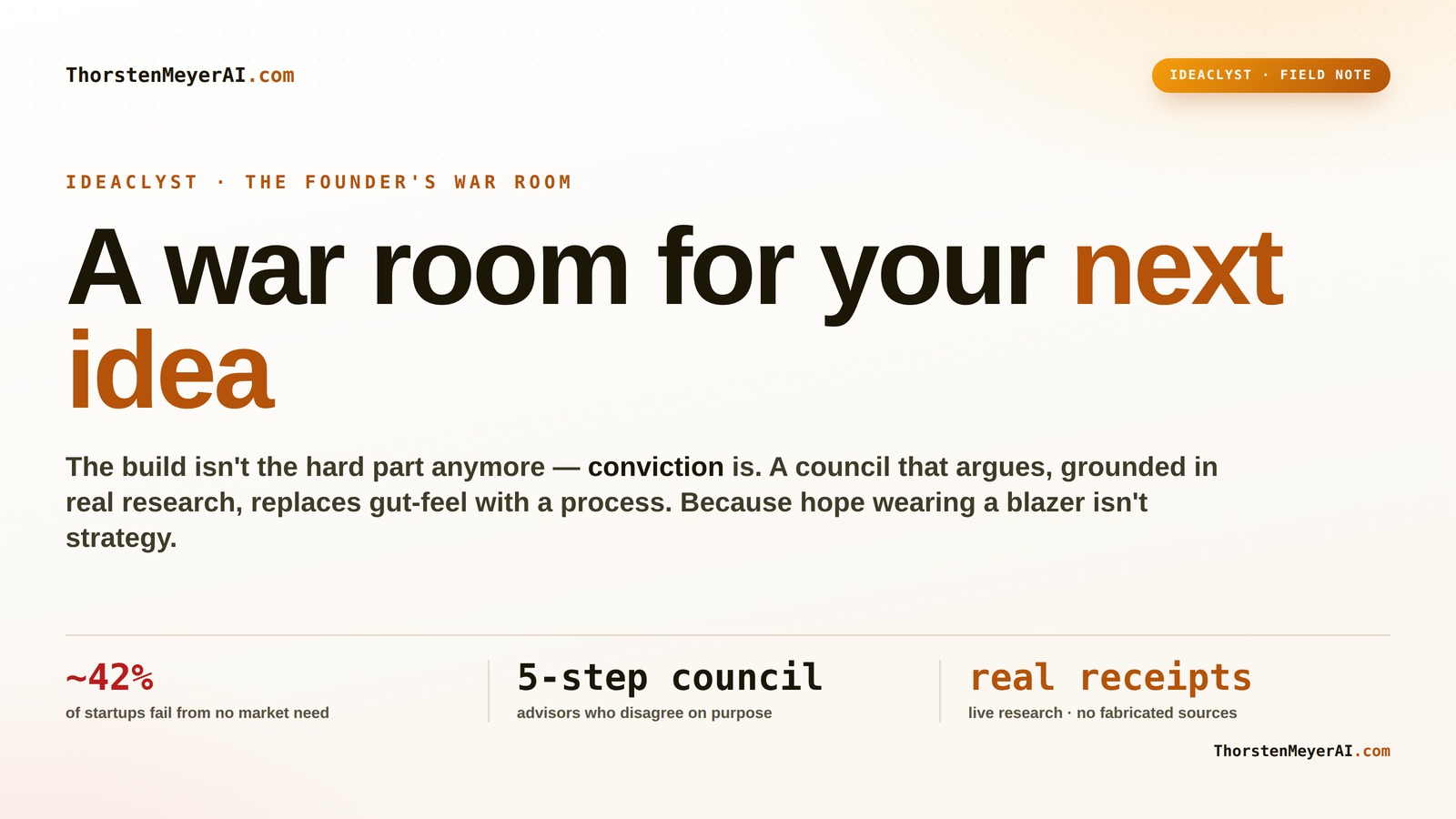
A war room for your next idea
The build isn’t the hard part anymore — conviction is. Knowing which idea deserves the next six months, and being able to defend it. Most founders answer with gut feel and optimistic math. That’s hope wearing a blazer. IdeaClyst replaces it with a process.
The most expensive decision is what to build
The single most valuable thing a tool can do is talk you out of the wrong six months. The numbers make the case better than any pitch.
Three tools in one — on your own machine
Strip away the framing and IdeaClyst is three things at once, all running locally with nothing leaving your laptop.
An AI council
Pressure-tests an idea you bring it — advisors who argue on purpose.
A discovery engine
Finds ideas you didn’t know to look for by hunting real demand signals.
A founder’s workspace
Carries winners from “interesting” all the way to “ready to build.”
Advisors who disagree on purpose
Not one confident, agreeable answer — a structured five-step deliberation where models play different roles and turn on their own work. The disagreement is the feature.
The five-step deliberation
A council that leads with the bad news surfaces the objections you’d otherwise find the expensive way, on month five.
Product strategy
Who’s it for, what’s the wedge, why now, what’s the business model.
Technical architecture
What would it actually take to build — and where’s the risk.
Critique pass
The council turns on its own work. Where’s the hand-waving? What kills this?
Second, independent critique
A different voice, a different angle — so blind spots don’t survive.
Final synthesis
Everything into one coherent founder packet: strategy, architecture, validation, plan.
When IdeaClyst cites a source, it actually fetched it
The hard departure from “ask an AI what it thinks of my startup.” It runs in a strict, real-data-only mode — if it can’t gather genuine evidence, it says so plainly rather than inventing a plausible paragraph.
Confidence with receipts
No fabricated statistics, no imaginary competitors, no made-up citations. The packet survives a skeptical co-founder or a sharp investor because the reasoning has receipts.
Market research first
Scouts the landscape before the council reasons about anything.
Competitor read
Real positioning, pricing signals, feature claims — differentiation vs. reality.
Validation with links
Not “talk to customers” — concrete signals & sources you can click.
From the blank page to build-ready
Evaluation is half the problem; the blank page is the other half. And a plan is worthless if it dies in a tab you never reopen.
Bring a space, not an idea
“AI for accountants,” “tools for indie game studios” — plus your goal and real capacity. It hunts demand signals across HN, Reddit, Product Hunt, GitHub, pricing pages.
- An honest market read — leads with the bad news when a space is hard
- An opportunity map — high pain, thin competition
- Ranked candidates — wedge, who pays, effort, risk, confidence
- each with KILL CRITERIA — when to walk away
A home and a forward path
Every promising idea gets carried forward, with every artifact in plain files on your disk.
- Validation tooling — sprint board, interview list, evidence browser
- Founder profile — a personal-fit lens; same discovery, different advice
- Build workspaces — funnel, personas, landing draft, version history
- “Build this idea” → a PRD + task queue, ready for a coding agent
Key Takeaways
- IdeaClyst transforms idea validation into a structured debate, reducing costly market mistakes.
- Grounding critique in live web research ensures ideas are based on real data, not model confidence.
- The local-first design protects your proprietary ideas, keeping them private and secure.
- A five-step AI council uncovers hidden flaws and surfaces objections founders might miss.
- Use the final Markdown plan as a living, versioned document to guide your next steps.
As an affiliate, we earn on qualifying purchases.
What Makes IdeaClyst Different from a Notes App or Brainstorm Session?
IdeaClyst isn’t just a fancy notes app or a casual whiteboard. It’s a structured, multi-layered debate chamber. When you bring an idea in, it doesn’t just accept it at face value. Instead, it hosts a five-step council—each step pushing your idea through critical filters.
Think of it like a courtroom for your idea, where different AI models play the roles of skeptical advisors, technical experts, and market strategists. You get a final report that’s as detailed as a strategic pitch, but written in plain Markdown. It’s a game-changer for founders tired of guesswork and wishful thinking.
As an affiliate, we earn on qualifying purchases.
Inside the AI Council: How Disagreement Sparks Better Decisions
Ever wondered why teams thrive when they challenge each other? IdeaClyst’s secret sauce is its AI council—five deliberate steps where models argue and critique your idea from different angles. Learn more about how AI councils work.
First, it questions who your target audience is and whether the timing makes sense. Next, it sketches out what it would take to build, highlighting risks and technical hurdles. Then, it plays devil’s advocate, attacking assumptions and unproven parts. A second critique ensures no blind spots slip through. Finally, it synthesizes the debate into a clear, actionable plan that’s ready to pitch or build.
For example, a founder testing a new AI-powered tool can see where their assumptions clash, saving months of misguided development.
As an affiliate, we earn on qualifying purchases.
Grounding Ideas in Real-World Research, Not Just Model Confidence
Many AI tools sound confident, but that doesn’t mean they’re right. IdeaClyst stands out because it roots each critique in live web research, giving your idea a reality check.
Instead of relying solely on the model’s memory, it pulls in fresh data—market trends, competitor moves, customer feedback—directly from the web. This process drastically cuts down false positives, like when an AI claims an idea is ‘hot’ without evidence. According to recent data, building on shaky assumptions can cost over $150,000 in misaligned products, so grounding your validation is critical.
For instance, by verifying market growth rates and customer pain points with real data, founders avoid chasing illusions.
As an affiliate, we earn on qualifying purchases.
Your Idea’s Private War Room: Why Local-First Matters
Most AI tools send your data to the cloud. Not IdeaClyst. It runs entirely on your machine, writing reports directly to your disk. Why does that matter? Because your ideas are your most valuable asset. Learn more about local-first AI tools.
Imagine your raw concepts, early prototypes, and strategic notes all stored safely on your own device. No third-party servers, no data leaks, no subscription traps. It’s developed privately and is not publicly available.
This local-first approach is a game-changer for privacy-conscious founders, especially when discussing sensitive ideas or proprietary plans. Think of it as your secret bunker—secure, private, and always accessible.
The Founder’s Workspace: From ‘Interesting’ to ‘Ready to Build’
It’s easy to get stuck in the ‘interesting idea’ phase. IdeaClyst helps founders push ideas from curiosity to clarity and readiness. After the council debates, you get a comprehensive plan—strategy, architecture, validation tests—all neatly organized in Markdown files.
This workspace isn’t just a report; it’s a living document. You can version it, share it, or embed it into your pitch deck. It turns fuzzy concepts into a concrete, defendable plan.
For example, a startup planning to launch a new SaaS product can walk away with a detailed blueprint, ready to present or prototype.
How to Use IdeaClyst Effectively in Your Startup Workflow
- Define a clear idea or hypothesis you want to validate.
- Input your idea into IdeaClyst, framing it in a sentence or paragraph.
- Let the AI council run its five-step debate, critique, and synthesis.
- Review the detailed founder packet generated—strategy, risks, validation tests.
- Refine your idea based on insights, then proceed to build or pitch with confidence.
Pro tip: Use the final Markdown report as a living document—update it as your idea evolves or as new data comes in.
Is IdeaClyst Worth It? Who Should Use It and Why
IdeaClyst is perfect for founders who want to cut through guesswork, validate ideas rapidly, and keep their data private. It costs nothing to try and pays off in saved time and money.
While it’s not a magic wand, it’s a serious upgrade from casual brainstorming or relying on gut feelings alone. Solo founders, early-stage startups, and small teams especially benefit from its structured debates and grounded research.
Think of it as your personal war room—always ready, always private, and always helping you make smarter bets.
The Main Benefits and Potential Drawbacks
Benefits: Faster validation, fewer costly mistakes, privacy, structured debate, grounded research, ownership of data.
Drawbacks: Requires familiarity with Markdown and command-line, not a replacement for human validation, initial learning curve, limited to technical founders comfortable with local tools.
For example, some founders might find the setup intimidating at first but will appreciate the control and privacy it offers.
Real-World Success Stories (or Hypotheticals) of IdeaClyst
Imagine a solo founder trying to validate a new SaaS idea. Using IdeaClyst, they debate, critique, and plan in just days instead of months. The detailed report reveals a weak market fit, saving thousands in development costs. Or picture a small team refining product architecture before a big pitch—each step documented and debated in their private war room.
While actual case studies are emerging, the core benefit remains: smarter, faster decision-making grounded in real research and structured critique.
Frequently Asked Questions
What exactly is IdeaClyst?
IdeaClyst is a local-first tool that creates a structured ‘war room’ for testing, debating, and refining startup ideas. It combines AI-driven critique with live web research, all stored on your own machine.
Is IdeaClyst suitable for remote teams?
Yes. Since it runs locally, your team can share the generated Markdown files and collaborate asynchronously. No cloud account needed, making it ideal for remote or privacy-focused teams.
How much does it cost?
IdeaClyst is developed privately and is not publicly available.
Can it replace human validation?
No, it’s a supplement, not a replacement. IdeaClyst accelerates and structures your validation process but still relies on human judgment and customer feedback for final decisions.
Conclusion
Think of IdeaClyst as your personal battlefield—where ideas are tested, challenged, and sharpened before execution. It turns the chaos of multiple options into a clear, defendable plan, all while keeping your data private on your own machine.
In a world where building the wrong product can cost six figures, having a war room like this could be the smartest move you make. Ready to turn your fuzzy ideas into winning strategies? Your next big move starts here.
Halloween Picks
halloween
As an affiliate, we earn on qualifying purchases.